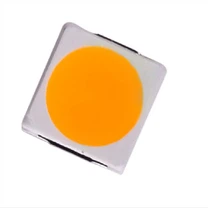
Growers generally have two options when it comes to LED gairneoireachta spectrums – "full spectrum" or "speictream leathan-", a appears as white light; and "speictream dearg/gorm", which can appear as purple or pink light.
An speictream dearg/gorm LED luminaires are often referred to as narrow band spectrum lights – because the wavelengths they emit are within a narrow band of light. LED luminaires that emit a "white" light are often referred to as "broad spectrum" or "full spectrum" éadroms because they cuimsigh ba leathannd den speictream solais (níos cosúla leis an ngrian) which renders a "white" light (úere are no true white wavelengths).
It should be noted that essentially all "white" LEDs are blue LEDs that are coated in a phosphor that converts the blue light into longer wavelengths. The phosphor absorbs the blue light and re-emits some or most of the photons into green and red light. This coating reduces an efficiency den stiúir i converting photons into usable PAR (photosynthetically active radiation) éadrom, but makes for a better work environment in sole source applications. The composition of the phosphor coating will help to determine the spectral quality of the white light emitted. To find the efficacy of your luminaire, you will need to divide the Flosc Fhótón Fótasintéiseach (PPF) of the luminaire, le its input wattage. The resulting efficacy luach, beidh represented in μmol/J. The higher the number, the more efficient the luminaire is at converting electrical energy into photons of PAR.

Red/Blue LEDs
The "purple/pink" LED luminaires that many associate with horticultural lighag bualadh, úsáid varying combinations of red and blue stiúirs, and are recommended le haghaidh greenhouse growers who are already receiving the full spectrum of light from the sun. Since photosynthesis peaks in the red and blue wavelengths it makes this spectrum, not only the most efficient for plant growth, but also the most energy efficient. From this perspective, if you are already getting full spectrum sunlight from outdoors, it would make the most sense to put most of your energy into wavelengths that are most optimal for photosynthesis, and where you will see the biggest energy cost savings. This combination is more energy efficient than "white" or full spectrum LEDs because blue and tá an éifeachtúlacht fhótóin is airde ag soilse dearga i gcomparáid le dathanna eile i.e. they convert the highest amount of electricity in photons, so you are getting more growth from your plants per dollar spent.
So, why do we need a combination of red and blue to grow plants, why can't we use just blue or just red LEDs? While red is most efficient for photosynthesis, having only red light would result in poor growth such as very elongated stems, so blue is added to keep plants compact and a more typical shape. On the other hand, you can't grow plants under only blue light either, as their growth and development will be adversely affected. Researchers have found over the years, that having a combination high red light to a lower percentage of blue light has been shown to be barrmhaith for the production de barraí ceaptha teasa that are already receiving light from the sun. Since there níl "ideal spectrum" for greenhouse barraí, most LED manufacturers offer a fixed ratio of red to blue that has been meastar the most optimum for horticultural crop growth and production.
Más saothróir cheaptha teasa tú atá ag iarraidh soilse a shuiteáil, molaimid our HortiLED Top 2.0 Dearg Bán (Mheán Gorm) spectrum. This LED spectrum has a softer pink dath, making it easier to work under and grade plandaí, than purple light, and has a high efficacy rating of 3.3 μmol/J―ídiú fuinnimh a laghdú chomh mór le 40 faoin gcéad i gcomparáid le córais traidisiúnta HPS. Faigheann saothróirí go seachadann sé resu iontachlts―either as a standalone LED installation or in a hybrid application (HPS-LED combination)―across all stages of growth for barra go leor lena n-áirítear barra fíniúnacha, ornáideachas; duilleog greens and cannabis.
Iomlán-Spectrum "White" LEDs
While in a greenhouse, the outdoor sunlight will balance out the "pink or purple" light emitted from LEDs, the same spectrum in a sole-source, dhíon application seachadann sp teorantaectrum an tsolais ar an mbarr agus is féidir a bheith unpleasant to work under. Therefore, many indoor growers have shifted away from speictream caol LEDs, to "white" leathan spectrum LEDs.
Broad spectrum LEDs have a lower efficacy than red/blue LEDs due to conversion, energy, and optical losses within the phosphor conversion process. However, since in dhíon applications where the luminaires are the amháin source of light, bsonra bóthairtrum LED luminaires are far better ná dearg/gorm ó shin they emit a wide range of wavelengths for your crop throughout the different growth stages. This is important because as we do more research, we are discovering that wavelengths such as green, which were previously thought of as not very useful, are proving to be important in photosynthesis and certain morphological responses. Additionally, many full broad speictream luminaires can also emit energy in the far-red region, which can help promote stem extension and leaf expansion.
In environment with only red/blue light, workers will not be able to properly identify problems such as nutritional deficiency, tinneas and pests. So broad spectrum light is not only more pleasing to the eye, but also makes it easier to work and assess plant health.
Mar sin, cé gur féidir leat LED dearg/gorm a úsáid i bhfeidhmchláir foinse aonair, le sláinte an duine agus plant scouting being affected, we highly recommend using a speictream leathan LED. For growers in sole source applications, we offer a "daylight" spectrum option with the HortiLED 2 is fearr.0―ideal for growth of indoor crops such as cannabis and leafy greens.